
QSR Compliance for Medical Device Manufacturers: FDA Quality System Regulation Explained


Summary:
- The FDA Quality Management System Regulation sets quality requirements for manufacturers of finished Medical Devices.
- 21 CFR Part 820 covers areas such as design, manufacturing, complaint handling, labelling, packaging, and servicing.
- ISO 13485:2016 provides the main quality management framework used with applicable FDA requirements under the QMSR.
- Manufacturers should maintain documented processes and controls to support the quality, safety, and performance of their Medical Devices.
QSR compliance FDA helps Medical Device manufacturers meet FDA quality requirements under the Quality Management System Regulation and 21 CFR Part 820. The requirements include ISO 13485:2016, manufacturing controls, complaint handling, labelling, packaging, and servicing of Medical Devices.
QSR Compliance Under the FDA QMSR
Quality System Regulation (QSR) is a common term used for FDA quality requirements for Medical Devices. However, from February 2, 2026, the regulation was replaced by the Quality Management System Regulation (QMSR). QSR compliance FDA requirements are now covered under the updated 21 CFR Part 820.
The QMSR aims to improve the way Medical Device manufacturers manage quality. It requires manufacturers to establish and follow a quality management system so their devices consistently meet the required specifications and applicable FDA requirements.1
FDA 21 CFR 820 Requirements for Manufacturers
FDA 21 CFR 820 covers important quality activities for finished Medical Devices. These activities include design, manufacturing, packaging, labelling, storage, installation and servicing of devices intended for human use.2
| Requirement | What It Applies To |
| Finished devices | The requirements apply to finished devices intended for human use that are made in the United States or imported into the United States. |
| Design and development | Class II, Class III and certain Class I devices must follow ISO 13485 Clause 7.3 and its subclauses for design and development. This also includes Class I devices automated with computer software. |
| Unique device identification | Manufacturers must document a system for assigning unique device identification to Medical Devices according to 21 CFR Part 830. |
| Complaint records | Manufacturers must keep complaint records with details such as the device name, complaint date, device identification, complaint details and any correction or corrective action taken. |
| Labelling and packaging | Before release or storage, manufacturers must check labelling and packaging for correct device identification, expiry date, storage instructions, handling instructions and other processing instructions. |
Table 1: Key Requirements for Medical Device Manufacturers Under FDA 21 CFR Part 820
What Does the Quality System Regulation Cover?
The QMSR mainly applies to manufacturers of finished Medical Devices. Some accessories can also be considered finished devices by the FDA and may come under Part 820. Examples include blood tubing and certain diagnostic X-ray components.1
However, Part 820 does not apply to manufacturers of components or parts of finished devices. Human cells, tissues, and cellular and tissue-based products regulated as devices are covered, with additional requirements under Part 1271.2
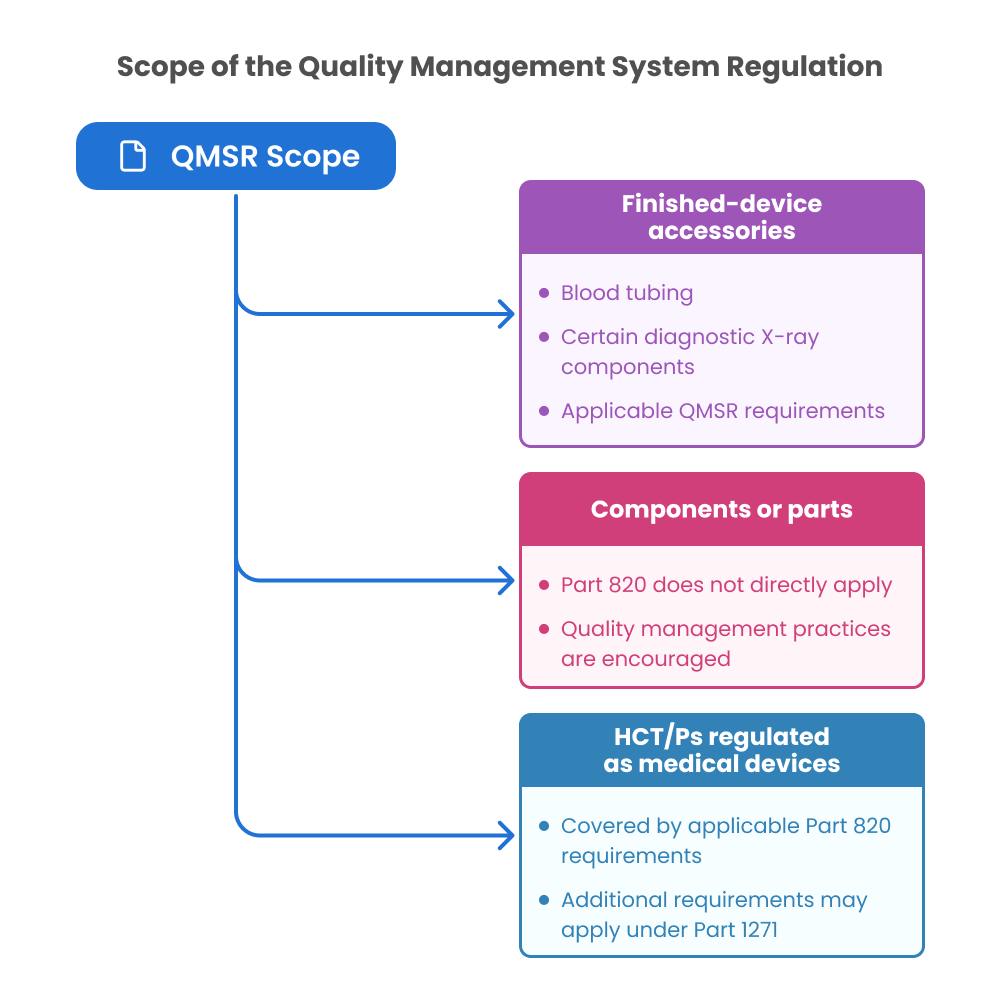
Figure 1
The figure illustrates the applicability of QMSR requirements to finished-device accessories, components or parts, and human cells, tissues, and cellular and tissue-based products (HCT/Ps) regulated as Medical Devices.1,2
ISO 13485 Requirements Within the FDA QMSR
ISO 13485:2016 is included in the FDA’s Quality Management System Regulation (QMSR) as the main quality management system framework for Medical Device manufacturers. It covers important quality areas such as device design, production, lifecycle controls, and risk management.1
Under 21 CFR 820.10, manufacturers must document a quality management system that follows the applicable requirements of ISO 13485 and Part 820. The QMS should match the type of device and its manufacturing activities. However, ISO 13485 does not replace FDA laws. If there is a conflict, the applicable FDA law or regulation takes priority.2
Maintaining Medical Device Manufacturing Quality (US)
Good manufacturing quality means keeping proper controls at every important stage of a Medical Device. This includes the following:
- Control manufacturing: Manufacturers need proper methods, facilities, and controls to make sure devices are produced correctly and meet the required requirements.
- Check labels and packages: Before a device is released or stored, its label and package should be checked for the correct device identification, expiry date, storage instructions, and handling instructions.2
- Maintain device quality: Proper repair, maintenance, and servicing help keep Medical Devices safe, effective, and reliable during their use.3
These activities help manufacturers maintain the quality, safety, and performance of Medical Devices.
Conclusion
- QMSR compliance helps Medical Device manufacturers maintain consistent quality through proper controls for design, manufacturing, labelling, complaints, and servicing.
- ISO 13485:2016 and FDA requirements work together under the QMSR, with applicable FDA laws and regulations taking priority where conflicts occur.
- Following the Quality System Regulation Medical Device requirements together with the applicable ISO 13485 requirements helps manufacturers maintain a structured approach to quality management.
- CliniExperts can support Medical Device companies with regulatory and compliance requirements, including ISO 13485 and quality management system-related services.4
References
1. Health C for D and R. Quality Management System Regulation (QMSR). FDA. February 2, 2026. Accessed September 6, 2026. https://www.fda.gov/medical-devices/postmarket-requirements-devices/quality-management-system-regulation-qmsr
2. 21 CFR Part 820 — Quality Management System Regulation. Accessed September 6, 2026. https://www.ecfr.gov/current/title-21/part-820
3. Health C for D and R. Quality and Compliance (Medical Devices). FDA. January 30, 2026. Accessed September 6, 2026. https://www.fda.gov/medical-devices/device-advice-comprehensive-regulatory-assistance/quality-and-compliance-medical-devices
4. Pharma Regulatory Consultants, Regulatory Affairs Services in India -CliniExperts. Accessed September 6, 2026. https://cliniexperts.com/

Saurangi Sah
CliniExperts Services Pvt. Ltd.
Recent Posts
eCTD Publishing for FDA Drug Submissions: What Sponsors Need to Know
eCTD Publishing FDA helps sponsors organise regulatory information, prepare FDA submissions, follow submission standards, check electronic files for errors, and send complete submission packages throu..
EU MDR vs IVDR: Key Differences and Compliance Timelines

The European Union Medical Device Regulation and In Vitro Diagnostic Medical Device Regulation set different requirements for Medical Devices and diagnostic devices, covering their scope, classificati..
Contact us
Please feel free to talk to us if you have any questions. We endeavour to answer within 24 hours.