
How Much Does Medical Device Regulatory Approval Cost?


Summary:
-
- User Fees vs. Total Budget: FDA user fees are only a small part of the overall development budget. Non-clinical testing and clinical studies often account for a much larger share of the total investment.
-
- Small Business Discounts: Companies that qualify for FDA Small Business Determination may receive significant reductions in applicable premarket application fees.
-
- Pathway-Specific Costs: 510(k) submissions generally rely on comparative testing, De Novo requests require evidence to support a new classification and appropriate controls, while PMA applications typically involve extensive clinical evidence.
-
- Cybersecurity Costs: Connected devices may require additional spending on cybersecurity documentation, risk assessments, and penetration testing, regardless of the regulatory pathway.
-
- Value of Regulatory Consulting: Experienced regulatory consultants can help reduce the risk of Refuse-to-Accept holds, Additional Information requests, and costly delays during the review and launch process.
This guide breaks down the total Medical Device regulatory approval cost in the US, including FDA user fees, small business discounts, testing, and regulatory consulting expenses.
Estimating the total Medical Device regulatory approval cost involves more than just looking at FDA user fees. Costs can also include non-clinical testing, software validation, quality system requirements, clinical studies, and regulatory consulting. The actual investment depends largely on the device’s classification, risk level, and regulatory pathway.
Budgeting only for government fees can quickly lead to unexpected expenses. In many cases, testing, evidence generation, quality system implementation, and clinical studies account for a much larger share of the overall cost of bringing a Medical Device to the US market.
Understanding FDA Medical Device Approval Cost and Statutory User Fees
Calculating the FDA Medical Device approval cost starts with the statutory Medical Device User Fee Amendments (MDUFA) fees. The FDA updates these submission fees every year at the beginning of the federal fiscal year.
Eligible small businesses can receive significant discounts on FDA user fees through FDA Small Business Determination certification. However, this discount applies only to FDA fees and does not reduce the cost of third-party testing, consulting, or other regulatory services.
Table 1: Comparison of standard and small-business MDUFA user fees for the main FDA Medical Device submission pathways.
| Submission Type / Pathway | Risk Classification | Standard FDA User Fee | Small Business Qualified Fee |
| 510(k) Premarket Notification | Moderate Risk (Class II) | $28,653 | $7,163 |
| De Novo Classification | Novel Low-to-Moderate Risk | $191,020 | $47,755 |
| Premarket Approval (PMA) | High Risk (Class III) | $636,732 | $159,183 |
| Annual Establishment Registration | Mandatory Registration | $13,785 | $13,785 |
Evaluating 510(k) Clearance Cost and Testing Expectations
Estimating the overall 510(k) clearance cost means looking beyond the FDA user fee. Expenses can also include bench testing, biocompatibility studies, software validation, and cybersecurity requirements, which can make up a significant part of the total premarket cost.
For connected Medical Devices, cybersecurity can add further expenses regardless of the device’s classification. Activities such as developing threat models, preparing a Software Bill of Materials (SBOM), and conducting penetration testing may all be needed before submission.
Premarket Approval (PMA) Cost vs De Novo Classification Cost Dynamics
The Premarket Approval cost can vary widely, but human clinical trials are often one of the biggest expenses. For Class III devices, pivotal studies can significantly increase the overall development budget, sometimes reaching tens of millions of dollars.
The De Novo classification cost is different because there is no existing predicate device to rely on. Manufacturers may need to generate additional safety and performance evidence and establish appropriate risk controls, which can make De Novo a significant mid-range investment.
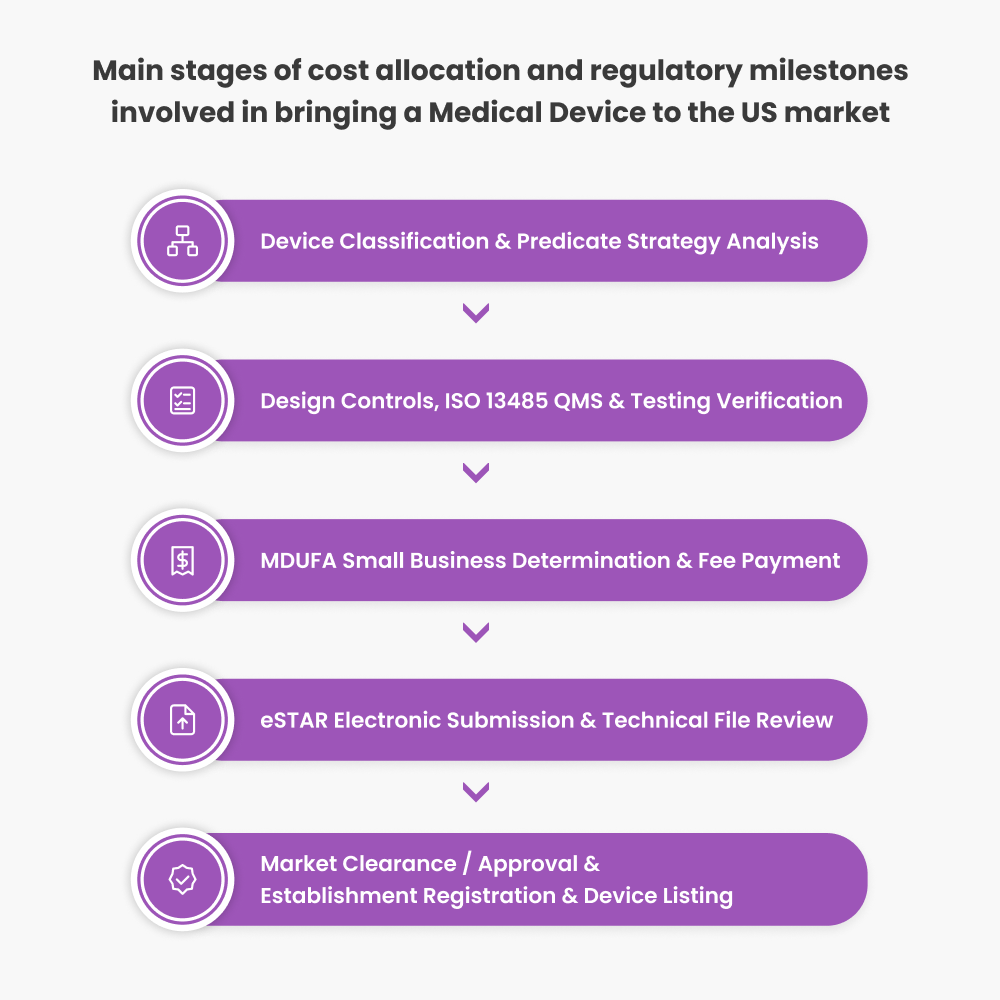
Figure 1
Strategic Planning for Medical Device Regulatory Consulting and US Medical Device Market Entry
Engaging Medical Device regulatory consulting services can help manufacturers avoid costly deficiencies and review delays. Experienced consultants can support eSTAR preparation, labeling reviews, and Pre-Submission (Q-Sub) interactions with the FDA.
Successful US Medical Device market entry starts with a realistic budget and a clear regulatory strategy. Planning for design controls, cybersecurity, testing, and regulatory requirements early can reduce rework and unexpected expenses later.
Ultimately, managing the total Medical Device regulatory approval cost means looking beyond FDA user fees. A well-planned budget that accounts for testing, regulatory documentation, and expert support can make the clearance process more predictable and help manage overall FDA compliance costs effectively.

Recent Posts
QSR Compliance for Medical Device Manufacturers: FDA Quality System Regulation Explained
QSR compliance FDA helps Medical Device manufacturers meet FDA quality requirements under the Quality Management System Regulation and 21 CFR Part 820. The requirements include ISO 13485:2016, manufac..
eCTD Publishing for FDA Drug Submissions: What Sponsors Need to Know
eCTD Publishing FDA helps sponsors organise regulatory information, prepare FDA submissions, follow submission standards, check electronic files for errors, and send complete submission packages throu..
Contact us
Please feel free to talk to us if you have any questions. We endeavour to answer within 24 hours.