
National Drug Code (NDC): Complete FDA Guide for Pharma Companies


Summary:
- The National Drug Code FDA is a unique identification system used to clearly distinguish drug products in the United States.
- It is made up of three segments that represent the labeller, product, and package details of a medicine.
- Companies involved in manufacturing, repackaging, or relabelling must obtain an NDC labeller code from the FDA.
- NDCs are assigned through Structured Product Labelling submissions and may also be reserved before product launch.
- The NDC Directory FDA helps companies maintain accurate listings, track product information, and avoid regulatory errors.

The National Drug Code or NDC system works as a structured method for identifying Drug products in the United States. It describes the format, assignment process, and regulatory requirements for companies that must obtain and maintain labeler codes. It also highlights when new NDCs are needed, how numbers are reserved and submitted, and how the NDC is applied in regulatory tracking and product listing within the Drug listing USA framework.
What is the National Drug Code (NDC)?
The National Drug Code (NDC) is a unique numeric identification used in the United States to distinguish Drugs. Every finished Drug product, as well as any unfinished Drug that falls under listing requirements, must be assigned its own NDC. This code helps identify the the company responsible for the Drug, its formulation, and its packaging details, for accurate tracking and regulation.1 The concept reflects the foundation of the NDC code USA used in pharmaceutical regulation.
Format and Structure of an NDC
The NDC consists of three segments:
- Labeler Code
- Product Code
- Package Code
These segments together form a 10- or 11-digit number depending on configuration.1 The table below shows the structure of the three segments of NDC along with their lengths assigning authority, and purpose consistent with the FDA Drug identification system practices.
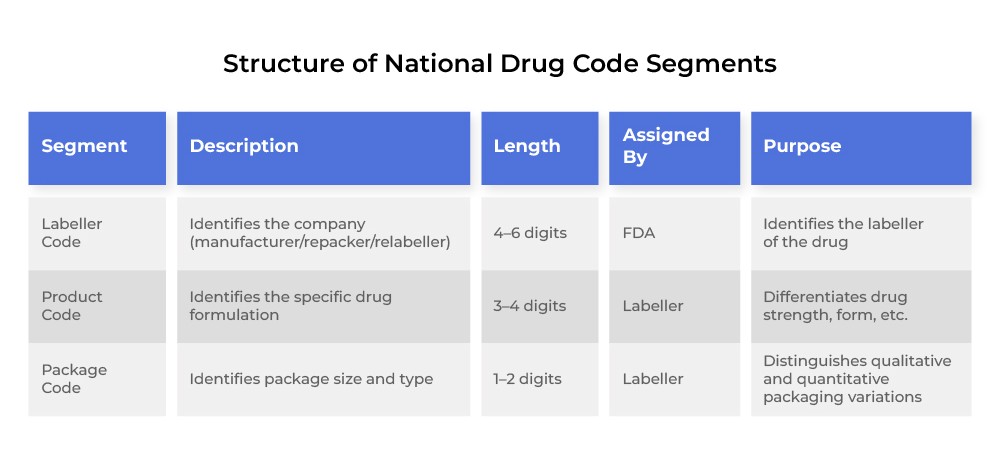
Who Must Obtain an NDC Labeller Code and How the FDA Assigns It
Any individual involved in activities such as repacking, manufacturing, private label distribution, or relabelling of a Drug, must obtain an NDC labeller code. To obtain a labeller code, companies must provide:
- Types of Drugs handled (human, animal, prescription, OTC, etc.)
- Information on the activities performed (manufacturing, repacking, etc.)
- Company name and contact information (address and email address)
Once assigned, companies must update their information within 30 days of any changes. This ensures accuracy in the NDC directory FDA and supports regulatory transparency.1
How NDC Numbers Are Assigned, Reserved, and Submitted to the FDA
NDCs are proposed when Drug listing information is submitted through Structured Product Labelling (SPL) submissions. When a company submits listing information for the first time, FDA evaluates whether the proposed NDC meets regulatory requirements.
If valid and not previously assigned to any other Drug or package, FDA assigns the NDC upon acceptance of the listing. Companies may also reserve an NDC for up to two years by submitting required details such as:
- Strength of each active ingredient of the Drug
- Active ingredient name
- Route of administration in case of a finished Drug
- Dosage form in case of a finished Drug
Reservation ensures that a unique identifier is secured before commercial distribution begins, aligning with the National Drug Code FDA regulatory process.1
When a New NDC Is Required for Drug Product Changes
A new NDC is required when significant changes occur in a Drug product, such as:
- Changes in proprietary or established name
- Changes in classification (Rx to OTC, etc.)
- Changes in active ingredient or strength
- Changes in physical characteristics
- Changes in dosage form
- Changes in intended use (human vs animal)
If only the package size or type changes, only the package code is updated while retaining the same product code, unless no combinations remain available. This ensures consistency in the NDC code USA structure.2
FDA Restrictions on NDC Usage and Misbranding Risks
FDA regulations strictly prohibit misuse of NDCs. Under § 207.37, a product may be considered misbranded if an NDC is:
- Used to represent a different Drug
- Applied to non-drug products such as supplements or Medical Devices
- Used to imply FDA approval
Misuse of NDCs can lead to regulatory violations. Additionally, discontinued products that resume marketing without changes must retain the original NDC.3
Importance of FDA NDC Directory Data for Pharma Companies
The information in the National Drug Code (NDC) Directory helps pharmaceutical companies understand regulatory expectations, maintain accurate product listings, and ensure proper Drug identification across the U.S. supply chain.4 It provides structured, standardized data that companies must submit and maintain through Structured Product Labelling (SPL), making it essential for regulatory reporting, internal data consistency and compliance with NDC directory FDA requirements.5
These points highlight the key ways pharma companies use and rely on NDC Directory data in practice:
- The NDC Directory is updated daily and contains only data submitted by labellers, so companies must ensure their listings remain accurate and current.4
- It helps pharma companies track key product details such as proprietary name, dosage form, route of administration, strength, and marketing status, which are important for labelling and compliance.5
- Companies can use the directory to verify how their products are represented in FDA records, supporting transparency and alignment of product data across systems.4
- NDC assignment does not indicate FDA approval, so companies must avoid implying approval based solely on an NDC number to remain compliant with regulations.5
- Marketing start and end dates included in the directory help firms manage product lifecycle updates and maintain accurate listing status within the Drug listing USA framework.4
The NDC DirectoryFDA helps companies maintain accurate listings, track product information, and avoid regulatory errors.
Conclusion
The NDC is a unique number used to identify Drug products and helps the FDA and pharma companies keep track of Drugs in a clear and organized way. Companies must follow FDA rules when assigning and updating NDCs to keep their information accurate and latest. The NDC Directory also helps companies check product details and maintain correct listings, which supports proper reporting and compliance within the FDA Drug identification system.
References
1. eCFR :: 21 CFR 207.33 — What is the National Drug Code (NDC), how is it assigned, and what are its requirements? Accessed April 9, 2026. https://www.ecfr.gov/current/title-21/chapter-I/subchapter-C/part-207/subpart-C/section-207.33
2. 21 CFR 207.35 — What changes require a new NDC? Accessed April 14, 2026. https://www.ecfr.gov/current/title-21/part-207/section-207.35
3. 21 CFR 207.37 — What restrictions pertain to the use of the NDC? Accessed April 14, 2026. https://www.ecfr.gov/current/title-21/part-207/section-207.37
4. National Drug Code Directory | FDA. Accessed April 9, 2026. https://www.fda.gov/drugs/drug-approvals-and-databases/national-drug-code-directory
5. Research C for DE and. NDC Product File Definitions. FDA. Published online August 9, 2024. Accessed April 9, 2026. https://www.fda.gov/drugs/drug-approvals-and-databases/ndc-product-file-definitions

CliniExperts - Your reliable partner for Comprehensive Compliance Solutions. We offer 360 degree Global Regulatory Solutions related to Pharma, Medical Devices and In-Vitro Diagnostics.
CliniExperts
CliniExperts Services Pvt. Ltd.
Recent Posts
US Regulatory Due Diligence for Pharma and Device Companies Expanding into America
FDA regulatory due diligence involves reviewing the key regulatory requirements before entering the United States market. A structured review helps identify compliance gaps, improve regulatory readine..
Cosmetic Product Compliance in the US Under MoCRA: What Foreign Brands Must Know
MoCRA has introduced several requirements for Cosmetic companies selling products in the United States. These include facility registration, product listing, safety documentation, recordkeeping, serio..
Risk Mitigation Through FDA Q-Submission Consulting

Short Description The FDA Q-Submission Program is an important regulatory pathway that helps Medical Device sponsors reduce potential risks before submitting a formal application. By obtaining early F..
Contact us
Please feel free to talk to us if you have any questions. We endeavour to answer within 24 hours.